
Threaded inserts and machine screws are the professional way to attach a bolt-on guitar neck. Whether you’re fixing stripped screw holes, upgrading your Strat for better tone, or building a custom guitar from scratch — this FAQ has you covered.
We’ve put together these answers based on thousands of conversations with guitarists, luthiers, and builders from all around the world. Nearly 8,000 players on every continent trust Nectite inserts in their instruments. If your question isn’t answered here, get in touch — we’re always happy to help a fellow guitar nerd.
About Threaded Inserts & Nectite Products
What are threaded inserts for guitars?
A threaded insert is a small metal sleeve with external threads that cut into wood and internal threads that accept a machine screw. Once installed in the neck heel, the insert creates a permanent, reusable metal-to-metal connection between your guitar’s neck and body.
Traditional wood screws grip the wood fibers directly. Every time you remove and reattach the neck, those fibers get a little more torn up — eventually the screw holes strip out and the joint becomes loose. Threaded inserts eliminate this problem entirely. You can remove and reattach your neck as many times as you want without any wear on the wood.
This isn’t some new invention, either. High-end guitar builders and luthiers have used threaded inserts for decades. Learn more about why threaded inserts are better for bolt-on guitars.
What’s the difference between wood screws and machine screws with threaded inserts?
Wood screws have coarse, tapered threads designed to cut directly into wood. They work — until they don’t. After repeated removal and reinstallation, the wood fibers they grip get torn and compressed. The result? A loose joint, reduced sustain, and all the tone problems that come with a neck that isn’t properly coupled to the body.
Machine screws, combined with threaded inserts, create a completely different kind of connection. The insert cuts its own permanent threads into the wood during installation. After that, the machine screw threads into the metal insert — metal on metal. This joint can be tightened, loosened, and retightened indefinitely without any wear whatsoever.
For a deep dive into the engineering behind this, check out our article: Your Guitar Neck Is Held On by Hope (and Four Mediocre Screws).
What material are Nectite inserts and screws made of?
Nectite threaded inserts are manufactured from zinc-plated carbon steel. This material provides excellent strength and corrosion resistance — more than enough for a guitar neck joint that needs to stay tight for decades.
The machine screws are available in multiple finishes to match your guitar’s hardware aesthetic, including stainless steel, black, gold, nickel, relic, and hex-drive options. No matter what your guitar looks like, there’s a Nectite kit that fits.
What’s included in a Nectite kit?
Every Nectite set includes:
- 4 threaded inserts — sized for your guitar type
- 4 machine screws — in your chosen finish and length
- 1 free Nectite Mounting Tool — our proprietary tool for installing the inserts straight and true
- Installation instructions — clear, step-by-step guide with photos
The Nectite Mounting Tool is included free with every order. It’s a tool we invented specifically to make installation easier and more precise — you won’t find it anywhere else.
What sizes and finishes are available?
We offer two thread sizes — M4 and M5 — in multiple screw lengths (40 mm and 45 mm being the most common). The right combination depends on your guitar brand and body thickness. Further below we explain how to choose the right size.
Finishes include:
- Stainless steel — the classic, corrosion-proof choice
- Black — sleek, modern look
- Hex-drive — for players who prefer an Allen key over a Phillips head
- Gold, nickel, and relic finishes — match vintage or custom hardware
Browse all options in our shop.

Nectite black machine screws and threaded inserts — one of several finish options.
Compatibility & Sizing
Will Nectite inserts work with all guitar brands?
Yes! Nectite threaded inserts are designed to work with all bolt-on neck guitars — Fender, Squier, Ibanez, ESP, Schecter, Jackson, Yamaha, Cort, Harley Benton, and many more. If your guitar has a bolt-on neck with four screws (or sometimes three or six), our inserts will work.
The key is choosing the right size. Most Fender-style guitars use M4 45 mm screws, while Ibanez and many Asian-made guitars often use M5 screws. If you’re unsure, check our sizing guide below or contact us — we’ll help you figure out the right kit.
Do they fit Fender guitars (Strat, Tele, Jazz Bass, Precision Bass)?
Absolutely. Fender-style guitars — including Stratocasters, Telecasters, Jazz Basses, and Precision Basses — are the most common platform for threaded inserts. The standard Fender Body is about 28mm thick at the neck pocket , making the M4 × 45 mm kit the perfect fit.
This applies to Fender USA, Fender Mexico, Fender Japan, Squier, and most other Fender-licensed instruments. When in doubt, measure your body at the neck pocket — we explain how below.
Do they fit Ibanez guitars?
Yes. Ibanez bolt-on guitars (RG, S, Jem, and others) typically use slightly bigger screws than Fender-style instruments. For most Ibanez models, the M5 × 40/35 mm kit is the right choice, specifically sized for Ibanez bolt-on guitars with the All Access Neck Joint (AANJ). Always verify by measuring your body at the neck pocket.
Can I use them on bass guitars?
Yes — Nectite inserts are popular among bass players. The installation process is identical to a 6-string guitar. Most Fender-style basses (Jazz Bass, Precision Bass) use the the slightly shorter M4 × 4o mm kit. Bass necks are heavier than guitar necks, so a solid, repeatable joint is especially important.
Which size do I need — M4 or M5?
Here’s a simple rule of thumb:
- M4 screws (7.3 mm head diameter) — for Fender-style guitars with standard screw heads. This is the standard for Strats, Teles, Jazz Basses, and P-Basses.
- M5 screws (9 mm head diameter) — for guitars with bigger neck screws, typically Ibanez and many Asian-built instruments.
To check: look at the heads of your original screws and the holes in your neck plate. If the holes look large and the screw heads are chunky, go M5. If they’re smaller and more delicate, M4 is your pick. M5 screws are also slightly heavier and provide maximum rigidity — four M5 screws with inserts add roughly 50 g to your instrument.
How do I measure my guitar neck screws?
If you’re replacing existing screws, simply measure their length and choose the closest Nectite equivalent. If you’re starting fresh, measure the body thickness at the neck pocket — that’s the area of the body where the neck sits.
- Fender Stratocasters typically measure about 28 mm at the neck pocket → 45 mm screws are perfect.
- Thinner bodies (around 24 mm, like some Jazz Basses) → 40 mm screws work great.
- If your guitar uses different screw lengths in different positions, or you need more than 4 screws, just get in contact — we’ll sort it out.
Do threaded inserts work with roasted (torrefied) maple necks?
Yes, but with a little extra care. Roasted (torrefied) maple is more brittle than regular maple because the heat treatment removes moisture and changes the wood’s cellular structure. This makes it even more important to drill precise, clean pilot holes.
Our recommendations for roasted maple:
- Use a drill press whenever possible for perfectly straight holes.
- Drill slowly and let the bit do the work — don’t force it.
- Thread the inserts in gently using the Nectite Mounting Tool. If you feel unusual resistance, back out and check the alignment before continuing.
- Practice on a scrap piece of roasted maple first if you have one available.
Threaded inserts are actually an excellent match for roasted maple necks, because the permanent metal threads mean you’ll never have to re-drill or stress the brittle wood again.

Measure your body at the neck pocket to determine the correct screw length.
Installation
Is it hard to install threaded inserts?
Not at all. Most customers report that installation is surprisingly straightforward. Every Nectite order includes our free mounting tool and clear instructions. If you can drill a hole and turn an Allen key, you can install threaded inserts.
That said, we always recommend reading the instructions carefully before starting, and practicing on a scrap piece of wood first. Drilling into your favourite guitar is a one-way street — take your time and get it right. For a full walkthrough, see our guide: How to Install Threaded Inserts in a Guitar Neck — Step by Step.
What tools do I need to install threaded inserts?
Here’s what you’ll need:
- A drill — a drill press is ideal for perfectly perpendicular holes, but a handheld power drill works fine with a steady hand.
- The correct drill bit — 6.5 mm for M4 inserts, 8.5 -9 mm for M5 inserts.
- The Nectite Mounting Tool — included free with every order. This is what you use to thread the inserts into the wood. You can clamp it into any drill chuck.
- Optional: a countersink bit — to create a clean, bevelled edge around each hole for a professional finish.
Some people use a bench drill with our mounting tool to thread the inserts in, turning the chuck by hand. This gives excellent control and is described in our instruction manual (PDF).
What drill bit size do I need?
The pilot hole size depends on your insert size:
- M4 inserts → 6.5 mm drill bit
- M5 inserts → 8.5 mm drill bit (9mm, with roasted wood)
These sizes create a snug fit that lets the insert’s external threads bite properly into the surrounding wood. A hole that’s too small makes threading difficult and risks cracking; a hole that’s too large won’t grip well. Stick to the recommended sizes.
Can I install them without a drill press?
Yes. A drill press makes it easier to get perfectly straight holes, but plenty of our customers have installed inserts successfully with a handheld power drill. The key is to go slowly, keep the drill perpendicular to the surface, and double-check your alignment before drilling.
A good trick: use a small square or a drill guide to keep your bit straight. And remember — the Nectite Mounting Tool helps correct minor alignment issues as you thread the insert in, because it keeps the insert parallel to the screw axis.
Can I install them in an existing guitar (not just new builds)?
Absolutely — that’s actually the most common use case. Most of our customers are retrofitting inserts into guitars they already own and play. You’ll need to remove the neck, drill out the existing screw holes to the correct pilot size, thread in the inserts, and bolt everything back together with the new machine screws.
If your existing screw holes are already stripped or oversized, threaded inserts are the perfect fix — they cut fresh threads into the surrounding wood and create a joint that’s stronger than the original. See our guide: How to Fix Stripped Guitar Neck Screws — The Permanent Solution.
I jammed the thread of an insert or screw — what do I do?
It happens, and it’s not the end of the world. If a thread gets cross-threaded or damaged during installation, don’t try to force it — that’ll make things worse.
We’re happy to replace damaged screws and inserts free of charge — you just cover the shipping. Every kit comes with a little margin for error, and our instructions include tips to avoid cross-threading. Just get in touch and we’ll sort you out.
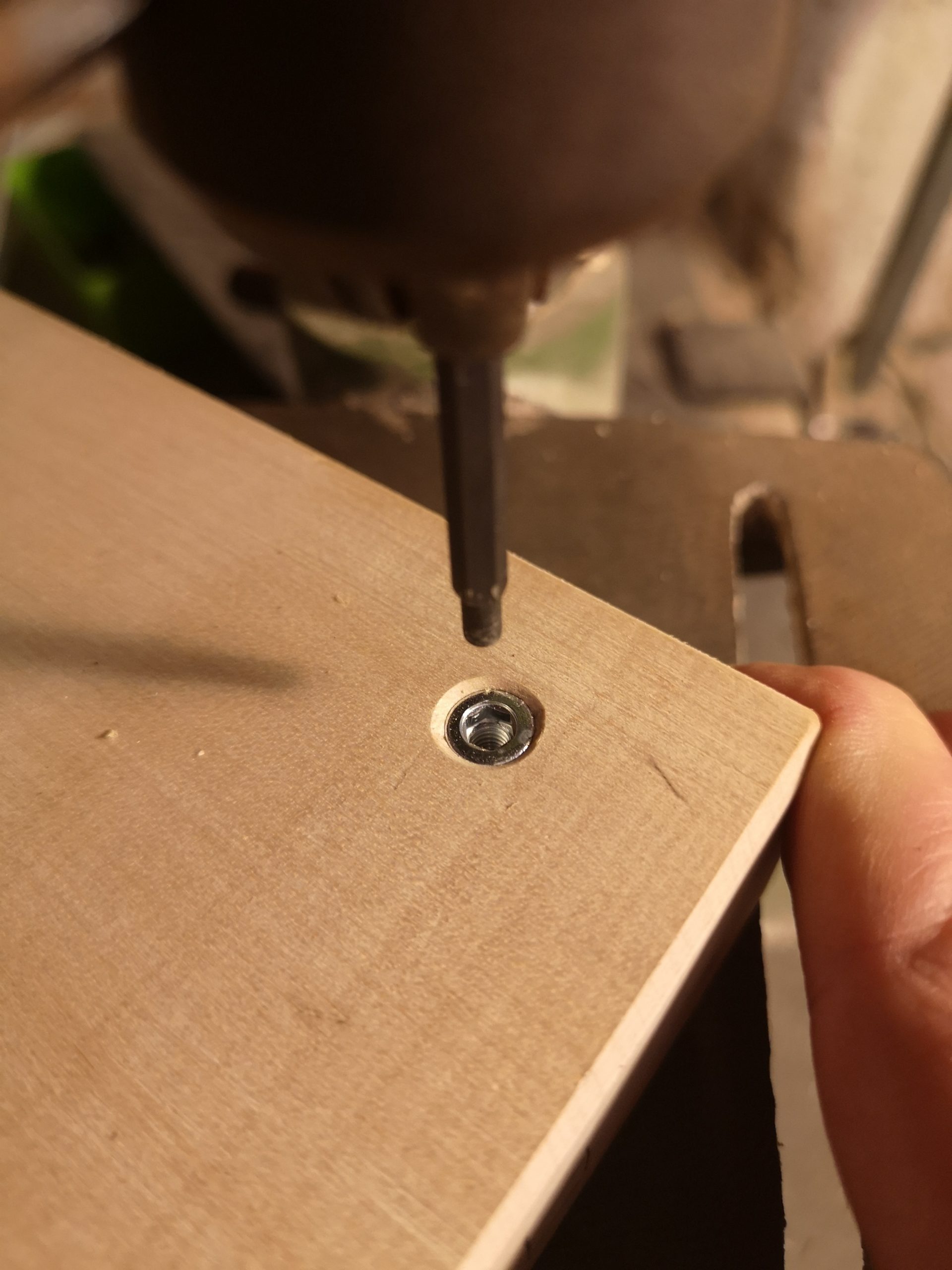
The Nectite Mounting Tool — included free with every order — makes installation precise and easy.
Tone, Sustain & Performance
Will threaded inserts change the tone of my guitar?
Threaded inserts won’t alter the fundamental character of your guitar’s sound. What they will do is help you get the best possible tone out of your instrument by providing a rigid, stable connection between neck and body.
A tight neck joint means better energy transfer from the strings through the neck and into the body. This can resolve issues like dead spots on the fretboard and improve the overall clarity and punch of your attack. Many players report a noticeable improvement — especially if their old wood screws were at all loose or worn.
As Julian Lage put it about using threaded inserts on his Telecaster: “It also makes the guitar sound better than ever.”
Do threaded inserts improve sustain?
They can — and here’s why. Sustain on an electric guitar is primarily about how efficiently the string’s vibration energy is retained (and not absorbed or dampened). A loose neck joint acts like a shock absorber: it allows the neck and body to move relative to each other, wasting vibrational energy and shortening sustain.
Machine screws with threaded inserts create a tighter, more consistent clamping force than wood screws. This means less energy lost at the joint and more of the string’s vibration reaching the pickups. The improvement is most noticeable on guitars with worn or stripped screw holes.
For the full science behind sustain in electric guitars, check out our article: Finally Revealed: Electric Guitars Don’t Have Sustain!
How does the neck joint type affect tone?
There’s a long-standing debate about bolt-on vs. set-neck vs. neck-through construction and how each affects tone. The short answer: the neck joint’s tightness and coupling quality matter more than the specific method used.
A well-executed bolt-on joint — especially one using threaded inserts — can rival a set-neck for sustain and energy transfer. The advantage of bolt-on is that it’s adjustable and serviceable: you can remove the neck for shipping, repairs, or adjustments without any permanent alteration.
We explored this topic in depth here: To Glue or To Screw — That’s the Question!
Use Cases & Applications
Can threaded inserts fix stripped screw holes?
Yes — this is one of the most popular reasons people buy Nectite inserts. Stripped screw holes are the #1 problem with bolt-on guitar necks. The traditional “fix” — stuffing toothpicks or matchsticks into the hole with wood glue — is temporary at best and doesn’t address the root cause.
Threaded inserts are the permanent solution. You drill the stripped hole out to the correct pilot size (which is larger than the original screw hole), thread in the insert, and you’ve got a fresh, reusable metal connection that will never strip again. It’s the same technique pro luthiers use.
Full guide here: How to Fix Stripped Guitar Neck Screws — The Permanent Solution.
Are threaded inserts useful for touring musicians?
Very much so. If you fly with your guitar and need to detach the neck for a compact travel case, threaded inserts are a game-changer. With wood screws, every removal cycle weakens the joint a little more. Over a busy touring schedule, that adds up fast.
With threaded inserts, you can remove and reattach your neck as many times as you need — before every flight, after every landing — with zero wear on the wood. The machine screws thread into the metal inserts cleanly every time, and the clamping force stays consistent. As session guitarist Altin put it: “I can unscrew the neck, pack it with me on a plane and not pay the extra seat.”
Can I convert a set-neck guitar to bolt-on?
In some cases, yes. Threaded inserts allow you to create a strong, removable bolt-on connection without permanently damaging the wood. This can be useful for instruments originally built with a glued neck that you’d like to make serviceable or adjustable.
That said, converting a set-neck to bolt-on is a more advanced modification and may affect the instrument’s value or playability. We’d recommend consulting a luthier before attempting this kind of conversion.
Can threaded inserts help fix bad string alignment?
Yes. If your strings aren’t centred over the fretboard, the problem is often a misaligned neck. Fixing this with wood screws means unscrewing the neck, repositioning it, and screwing it back in — but every cycle damages the screw holes a little more, especially if you need multiple attempts to get the alignment right.
With threaded inserts, you can adjust the neck position as many times as needed without any wear on the wood. Loosen the machine screws, shift the neck, tighten — done. It takes the anxiety out of what should be a simple adjustment.
Do threaded inserts help with seasonal neck adjustments?
Indirectly, yes. Wood moves with changes in humidity and temperature — guitar necks shift, bow, and settle with the seasons. Sometimes you need to detach the neck to shim the pocket, adjust the heel angle, or simply inspect the joint.
With wood screws, every trip through that cycle degrades the screw holes. With threaded inserts, you can service your neck pocket whenever the seasons demand it — confident that the joint will be just as tight when you reassemble.
Can I use threaded inserts for other parts of the guitar?
Definitely! While neck joints are our core product, threaded inserts have many other uses on a guitar:
- Pickguard and back plate covers — no more stripped holes from frequent access to the electronics cavity
- Strap buttons — who hasn’t worn out a strap pin hole?
- Direct-mount pickups — mount pickups directly to the body without a pickguard
- Tremolo spring covers
- Battery compartments — for active electronics
For these smaller applications, check out our Mini Threaded Inserts — specifically designed for pickguards, covers, and other lightweight hardware.
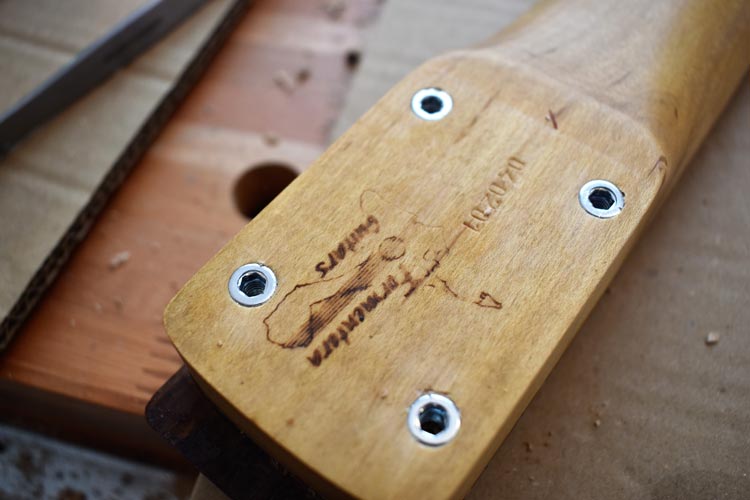
Threaded inserts installed in a Telecaster neck heel — clean, permanent, and ready for repeated use.
Ordering & Shipping
Where do you ship?
Everywhere! Nectite ships worldwide. We’ve sent kits to customers on every continent. Whether you’re in Berlin, Brisbane, or Buenos Aires — our inserts will reach you.
How long does shipping take?
Orders within Germany and the EU typically arrive within 2–5 business days. International shipping to the US, Canada, Australia, and elsewhere usually takes 5–14 business days, depending on your location and customs processing times.
If you need a specific delivery time or have special shipping requirements, get in touch and we’ll do our best to accommodate.
Where is Nectite based?
Nectite is a one-man operation based in Germany, run by a guitarist and builder with over 30 years of experience. This is a passion project — born from the frustration of stripped screw holes and the knowledge that there’s a better way to do bolt-on neck joints. Since 2020, nearly 8,000 guitarists around the world have trusted Nectite inserts in their instruments.
What is your return policy?
We want you to be completely happy with your purchase. Please see our full return policy for details. If you have any issues with your order — damaged threads, wrong size, or anything else — contact us directly. We’ll make it right.
Still Have Questions?
Whether it’s a tricky compatibility question, a custom sizing request, or just guitar talk — we’d love to hear from you.
Contact Us →You Might Also Find These Helpful
- How to Fix Stripped Guitar Neck Screws — The Permanent Solution
- How to Install Threaded Inserts in a Guitar Neck — Step by Step
- Your Guitar Neck Is Held On by Hope (and Four Mediocre Screws)
- Finally Revealed: Electric Guitars Don’t Have Sustain!
- To Glue or To Screw — That’s the Question!
- 3 Reasons Why Guitar Neck Screw Inserts Are Better for Bolt-On Guitars