
A Mildly Academic Investigation into Why the Most Important Joint in Your Guitar Uses 1950s Technology
Abstract
There are approximately 120 pounds of string tension trying to rip your guitar’s neck out of its body right now. And the only thing stopping that from happening? Four wood screws. Not bolts. Not precision-engineered fasteners. Wood screws — the same technology your grandfather used to hang a shelf bracket. This paper investigates the mechanical, metallurgical, and mildly alarming reality of bolt-on neck fastening, compares the humble wood screw to the threaded insert, and explains why the greatest design revolution in guitar engineering might be the cheapest upgrade you’ll ever make.
Fear not. The Professor brought diagrams.
1. Introduction: 120 Pounds of Tension and a Prayer
Here’s a thought experiment. Imagine you built a bridge. A small one — just wide enough for a single person to cross. Now imagine the bridge must support a constant lateral load of 120 pounds, 24 hours a day, 7 days a week, for years. Decades, even.
Would you attach the structural members with… wood screws?
Of course not. You’d be arrested. Or at least very sternly talked to by an engineer.
And yet, that is precisely the engineering specification of a standard Fender-style bolt-on guitar. A set of electric guitar strings exerts approximately 100 to 120 pounds of tension (bass guitars: over 200 pounds), pulling the neck forward and upward with relentless enthusiasm. And the only thing resisting that force is four coarse-threaded wood screws driven into the end grain of a maple neck.
Leo Fender — a man who, we should remember, chose this design primarily because it made guitars cheaper to manufacture — would probably be surprised to learn that his cost-cutting compromise is still the industry standard in 2026.
But before we judge him too harshly, let’s understand what’s actually happening inside that neck pocket.
2. How Wood Screws Actually Work (or: The Gentle Art of Crushing Wood Fibers)
A wood screw does not “grip” wood the way a bolt grips a nut. It has no matching counterpart. Instead, a wood screw works by displacing and compressing the wood fibers around its thread path. As you drive the screw in, the coarse threads cut and wedge into the surrounding wood, creating a high-friction bond through material deformation.
This sounds impressive. It is not.
The entire holding strength of a wood screw depends on the structural integrity of the wood fibers immediately surrounding the thread track. And here’s the problem: those fibers are not infinitely resilient. Every time you remove and reinstall the screw, you slightly re-cut the thread path. The fibers compress. They don’t spring back. They fatigue.
After 2 to 5 removal cycles — which, for a guitar that needs occasional truss rod adjustments or setup work, can happen in the first year of ownership — the screw holes begin to lose their grip. The industry has a charmingly understated term for this:
“Stripped holes.”
In practice, it means your neck is getting loose. The clamping force is dropping. The coupling between neck and body is degrading. And you’re approaching the point where your guitar’s most critical structural joint is held together by friction, inertia, and optimism.
The traditional remedy? Stuff toothpicks and wood glue into the holes and try again. I am not making this up.
3. Enter the Threaded Insert: Engineering Strikes Back
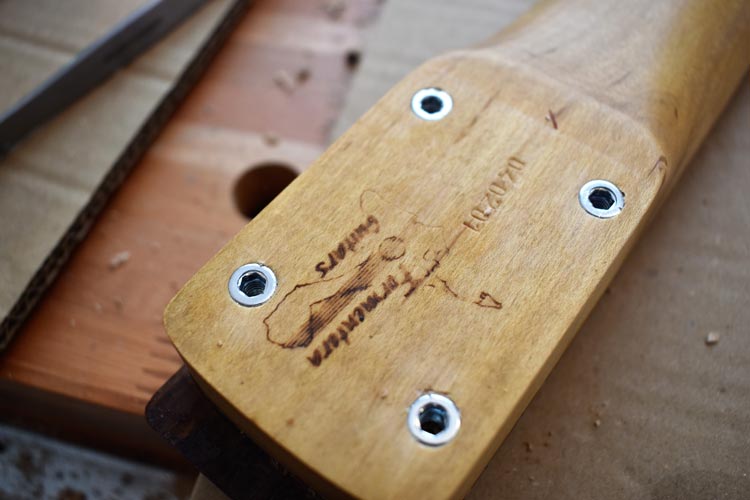
A threaded insert replaces the wood-screw-into-wood paradigm with something altogether more civilized: metal-on-metal threading.
The concept is simple. You embed a metal sleeve — a small cylinder with aggressive external threads — permanently into the guitar neck heel. The external threads grip the wood (once, during installation, like a one-time handshake that lasts forever). Inside the sleeve, precision-machined internal threads accept a standard machine screw.
The result is a two-stage fastening system:
- The insert grips the wood — anchored permanently by its external knife-threads, which cut into the wood fibers and distribute force across a much larger surface area than a wood screw.
- The machine screw grips the insert — metal threading into metal. No wood involved in the clamping action. No fiber degradation. No stripping.
Where a wood screw might survive 2 to 5 removal cycles before significant wear, a threaded insert system can handle 50 or more cycles with zero degradation. The metal threads don’t compress, don’t fatigue, and don’t care how many times you’ve taken your neck off to adjust the truss rod or pack the guitar for a flight.
| Property | Wood Screw | Threaded Insert + Machine Screw |
|---|---|---|
| Engagement mechanism | Fiber compression | Metal-to-metal threads |
| Clamping force | Moderate, inconsistent | High, precisely repeatable |
| Removal cycles before wear | 2–5 | 50+ |
| Maximum torque | Limited by wood shear strength | Limited by screw tensile strength |
| Failure mode | Stripped wood fibers | Basically doesn’t |
4. The Physics of Clamping Force (or: Why Tighter Is Better, Up to a Point)
In our previous investigation, the Professor established that coupling stiffness — not neck joint type — determines how efficiently vibration transfers between neck and body. And clamping force is the single biggest contributor to coupling stiffness.
In mechanical engineering, the preload (clamping force) generated by a fastener follows the torque-tension relationship:
F = T / (K × d)
Where T is the input torque, K is the nut factor (incorporating friction), and d is the nominal diameter.
Here’s the crucial difference:
- Wood screws: Maximum torque is capped by the shear strength of the wood fibers. Crank too hard, and the fibers fail. The screw spins freely. The clamping force drops to zero. You now have a Stratocaster-shaped paperweight.
- Machine screws in metal inserts: Maximum torque is limited by the tensile strength of the steel screw — which is dramatically higher than wood fiber shear strength. The friction coefficient is lower (metal-on-metal), meaning more of your applied torque converts into actual clamping force.
Technical estimates suggest that while wood screws provide adequate force for a stable joint, a threaded insert system can deliver 1,760 to 1,900 lbs of pressure across the joint surface. That’s not a neck joint. That’s an engineering clamp. You’re essentially mimicking the rigidity of a set-neck or neck-through construction — with the modularity of a bolt-on.
And here’s the kicker: that clamping force is repeatable. Every time you reassemble, you get the same pressure. Not “roughly similar” — the same. Try saying that about wood screws.
5. “But What Are They Made Of?” — A Metallurgical Interlude

This is where the Professor must put on his lab coat and address the Great Material Debate.
The research literature on guitar threaded inserts often assumes stainless steel (grades 316 or 303) as the default material. This makes for excellent academic papers. It’s also not what most real-world guitar inserts are actually made of.
The Nectite system uses carbon steel with zinc plating — and before anyone’s inner materials scientist starts objecting, let me explain why this is actually the smart choice.
The Case for Zinc-Plated Carbon Steel
There are two properties that matter for a guitar neck insert:
- Mechanical strength — Can the insert withstand the clamping force, string tension, and installation torque without deforming?
- Corrosion resistance — Will the insert hold up over decades inside your guitar neck?
Carbon steel delivers extreme mechanical strength — significantly higher than stainless steel, and in a completely different league from brass or zinc alloy. When you’re torquing a machine screw to clamp 120+ pounds of string tension, you want the hardest, toughest metal you can get. Carbon steel is that metal.
The zinc plating provides a sacrificial corrosion barrier. The zinc layer corrodes preferentially, protecting the steel underneath. For an indoor environment — which, let’s be honest, describes where 99.9% of guitars live — zinc plating provides more than adequate protection. Your guitar neck is not a submarine.
Why Not Stainless Steel?
Stainless steel (particularly 316 “marine grade”) offers superior corrosion resistance. It’s the go-to for surgical instruments, boat hardware, and outdoor architectural fixings. It’s also:
- Softer than high-carbon steel (lower on the Rockwell hardness scale)
- More expensive (200–400% premium over zinc-plated carbon steel)
- Prone to galling — a phenomenon where stainless steel threads cold-weld to each other during tightening, potentially seizing the screw permanently in the insert
For a guitar living in a case, a studio, or even a touring rig — none of the incremental corrosion resistance of stainless steel is worth the trade-offs in mechanical strength and cost.
The Materials Nobody Should Use
While we’re in the lab coat, let’s be thorough:
| Material | Strength | Corrosion Resistance | Guitar Verdict |
|---|---|---|---|
| Carbon steel + zinc plating | Extreme | Good (indoor/standard use) | Ideal balance of strength, cost, and durability |
| 316 Stainless steel | High | Extreme (marine grade) | Overkill. Softer. Galling risk. |
| Brass (C36000) | Moderate (soft) | Excellent | Too soft. Strips during installation in hard maple. |
| Zinc alloy | Low (brittle) | Moderate | Furniture-grade. Will creep under constant string tension. |
The brass contingent deserves special mention. Brass inserts are lovely in cavity covers and pickguards — low-stress, decorative contexts where machinability matters more than brute strength. Drive a brass insert into a hard maple neck heel under torque, and there’s a real risk of the insert fracturing or the internal threads stripping before you’ve even finished installing it. Save the brass for your trumpet.
6. The Roasted Maple Problem (or: How Premium Wood Became an Engineering Challenge)
In recent years, roasted maple has become the prestige material for guitar necks. The torrefaction process — heating wood in an oxygen-free environment — drives out moisture, hemicellulose, and volatile oils, yielding a neck that is more dimensionally stable, more resonant (arguably), and significantly more Instagram-worthy than plain old hard maple.
It’s also more brittle.
Standard hard maple has what engineers call elastic deformation capacity — when stressed, the wood fibers flex slightly before returning to their original shape. Roasted maple has had much of this elasticity baked out. When stressed beyond its (reduced) limit, it doesn’t bend. It cracks.
This matters enormously for insert installation. A threaded insert has aggressive external knife-threads designed to bite into wood. In standard maple, the surrounding fibers accommodate this intrusion by flexing slightly. In roasted maple, if the pilot hole is even fractionally too small, the internal stresses have nowhere to go. The wood shatters.
The luthier community has developed specific protocols for roasted wood:
- Oversize the pilot hole — Where standard maple uses a 6.5mm hole for an M4 insert, roasted maple may need 7.5mm (17/64”) to provide clearance for the insert body.
- Pre-tap the threads — Use a metal tap to pre-cut the thread path before driving the insert. This dramatically reduces installation torque on the surrounding wood.
- Always countersink — Bevel the entrance of the hole to prevent surface chipping as the insert enters.
- Go slow — Hand-turn the insert using a drill press chuck as a guide. No power driving.
The Nectite installation manual addresses these edge cases. A drill press is non-negotiable. Patience is mandatory. Read the instructions — even if you’re the type who normally doesn’t.
7. The Touring Musician’s Best Friend
Here’s a scenario. You’re a working guitarist. You have a gig in Berlin on Friday and a session in London on Sunday. You need to fly. Your guitar doesn’t fit in the overhead bin.
Option A: Check it in a hard case. Trust the baggage handlers who’ve been filmed throwing suitcases like shot-putters. Pray.
Option B: Remove the neck. Pack the body and neck separately in a padded gig bag that fits carry-on dimensions. Reassemble at the venue.
Option B is obviously superior — but it has a fatal dependency: can you remove and reattach the neck without destroying the joint?
With wood screws: maybe twice. Three times if you’re lucky and the maple is forgiving. After that, you’re carrying toothpicks and Titebond in your gig bag.
With threaded inserts: indefinitely. The machine screws return to the exact same depth and torque every time. The guitar’s setup — string height, neck relief, intonation — remains remarkably consistent between assemblies. Julian Lage reportedly described his instrument as sounding “better than ever” following the installation of inserts, likely because the original wood screw holes had degraded over years of touring and the fresh inserts restored optimal coupling.
Taylor Guitars understood this decades ago. Their acclaimed acoustic neck joint uses a bolt-in system with threaded inserts. It’s considered one of the best neck joints in the acoustic world — and it’s based on exactly the same engineering principle.
8. Why Fender Still Uses Wood Screws (or: Economics vs. Engineering)
If threaded inserts are mechanically superior in virtually every way, why doesn’t Fender just… switch?
Economics.
| Factor | Wood Screws | Threaded Inserts |
|---|---|---|
| Part cost per guitar | ~€0.10 | ~€2–3 |
| Labor (installation) | Seconds (one step, power driver) | Minutes (drill press, careful insertion) |
| Skill required | Entry-level / robotic | Trained technician |
| Tolerance for misalignment | Very forgiving (screw finds its own path) | None (machine screw must align with insert) |
| Production line speed | Very fast | Slower |
Multiply those differences across hundreds of thousands of guitars per year, and the economic argument for wood screws becomes overwhelming. A wood screw is a manufacturing miracle: cheap, fast, forgiving, and “good enough.”
But “good enough” is a business decision, not an engineering endorsement. It’s the reason your €1,500 American Professional Stratocaster ships with the same fastening technology as a €200 Squier Affinity. The neck joint — the most critical structural connection in the entire instrument — is the one place where even Fender decided that cost-efficiency matters more than engineering excellence.
The Professor makes no judgment. Well, maybe a small one.
9. The “Third Material” Objection (and Why It’s Nonsense)
Skeptics sometimes argue that inserting metal sleeves into the neck-body interface introduces a “third material” that disrupts the natural wood-on-wood resonance of the joint.
This argument has two problems:
- A wood screw is already a third material. It’s steel. In the joint. Touching the wood. The insert system doesn’t introduce metal where there was none — it optimizes the metal that was already there.
- The coupling interface is still wood-on-wood. The neck heel surface meets the body pocket surface. The insert sits inside the neck heel; the body side sees only the machine screw shaft passing through its through-hole. The vibrational contact area is unchanged — or rather, improved, because the coupling is now tighter and more consistent.
If anything, a threaded insert system provides a more uniform metal-to-wood interface than a wood screw, which creates irregular compression zones — spider-web micro-fractures radiating outward from the thread track. The insert’s knife-threads, by contrast, distribute the grip force across a larger and more symmetrical contact area.
The science is clear. The “resonance” objection is vibes. (Pun intended.)
10. Humidity, Stability, and the Long Game
Wood is a hygroscopic material. It swells when humid and shrinks when dry. Guitar necks are no exception.
In a dry environment (winter heating, air-conditioned studios, the cargo hold of a Boeing 737), wood cells contract. This causes fret sprout, neck relief changes, and — critically — loosened mechanical joints. The neck heel can shrink just enough to reduce the contact pressure inside the pocket.
With wood screws, this is a disaster waiting to happen. The screws were already at the limits of their clamping capacity, and now the wood is smaller. The joint gets sloppy. Micro-vibrations replace rigid coupling. Your tone suffers. Your intonation drifts.
With threaded inserts, the fix is elegant: tighten the machine screws by a quarter-turn. The insert doesn’t care about the humidity. The metal threads haven’t changed. You’re simply re-establishing optimal clamping force against a slightly different wood geometry. And when the humidity returns and the wood swells again? Loosen that quarter-turn back. No stripped holes. No degradation. No drama.
This is the kind of serviceability that wood screws cannot provide — because the one thing wood screws absolutely cannot tolerate is repeated tightening and loosening. It’s their kryptonite. It’s the exact operation that destroys them.
11. Conclusion: The Professor’s Prescription
Your guitar neck is important. It is, literally, the structural backbone of the entire instrument. The quality of its attachment to the body determines your sustain, your tuning stability, your ability to travel, and your long-term maintenance costs.
And in most guitars, that attachment relies on four wood screws whose engineering design philosophy can be summarized as: “it was cheap in 1950 and nobody complained loudly enough to change it.”
The threaded insert is the cure. Not because it’s exotic or expensive (it’s neither — a Nectite kit runs €7–9). Not because it turns your bolt-on into a set-neck (it doesn’t — but as we’ve established, that doesn’t matter). But because it replaces a single-use, degradation-prone, torque-limited wood-screw joint with a permanent, repeatable, high-strength mechanical coupling that will outlast you, your guitar, and probably your grandchildren’s interest in your guitar.
Install them once. Assemble and disassemble forever.
The Professor rests his case.
— The Mad Electric Guitar Professor
References
- Mottola, R.M. (2007). “Sustain and Electric Guitar Neck Joint Type.” American Lutherie, Issue 91, p. 52.
- Nuance Lab Guitars. “Converting Wood Screws to Machine Screws for Neck Joints.” nuancelabguitars.com.au.
- Lipman, Barry (2002). Guitar Questions: The Novice’s Guide to Guitar Repairs. Cherry Lane Music Co.
- Inserts Direct. “Reliable and Corrosion-Proof Connections: Choosing the Right Threaded Inserts for Your Wood Type.” insertsdirect.com.
- SkuttleFunk / Unofficial Warmoth Forum. “Threaded inserts — neck/body attachment.” unofficialwarmoth.com.
- Guitar Kit World. “Fixing Cracks & Loose Neck Joints Caused by Humidity.” guitarkitworld.com.
- Taylor Guitars. “Symptoms of a Dry Guitar.” taylorguitars.com.
- That guy on Reddit who insists wood screws are “fine” because “Leo Fender was a genius.” Primary source, comment karma: 3.
Related Reading
- To Glue or To Screw — That’s the Question! — Does the neck joint type even matter for sustain?
- Finally Revealed: Electric Guitars Don’t Have Sustain! — The ADSR definitions that will ruin forum debates forever
- 3 Reasons to Use Threaded Inserts in Your Guitar Neck
- How to Fix Stripped Guitar Neck Screws — A Step-by-Step Guide
- How to Install Threaded Inserts for Guitar Neck Bolts
- FAQ: Threaded Inserts for Guitars
Frequently Asked Questions
Are threaded inserts better than wood screws for guitar necks?
Yes. Threaded inserts provide metal-on-metal threading that delivers higher, more consistent clamping force and can withstand 50+ removal cycles without degradation. Wood screws begin to strip after just 2-5 removals because they rely on compressed wood fibers for grip.
What material are Nectite threaded inserts made of?
Nectite inserts are made of carbon steel with zinc plating. Carbon steel provides extreme mechanical strength (higher than stainless steel), while the zinc coating offers a sacrificial corrosion barrier that is more than adequate for indoor guitar use.
Can I install threaded inserts in a roasted maple neck?
Yes, but roasted maple is more brittle than standard maple, so you need to oversize the pilot hole (e.g., 7.5mm instead of 6.5mm for M4 inserts), pre-tap the threads, countersink the entrance, and install slowly with a drill press. See the Nectite installation manual for detailed instructions.
Do threaded inserts affect guitar tone or resonance?
If anything, they improve it. The higher clamping force creates tighter coupling between neck and body, which improves vibration transfer. The “third material” objection is unfounded wood screws are already metal in the joint. Inserts simply optimize that metal interface while keeping the wood-on-wood contact surfaces unchanged.