
A Mildly Academic Investigation into Why Everything You Know About Guitar Tone Is Acoustically Wrong
By The Mad Electric Guitar Professor
Abstract
The concept of electric guitar sustain has obsessed guitarists for decades. They swap pickups, upgrade bridges, install titanium saddles, and argue on forums about whether a Les Paul out-sustains a Stratocaster. The word “sustain” appears in virtually every electric guitar review ever written. There’s just one small problem: according to the very science of sound itself, electric guitars don’t have sustain. Not even a little. What guitarists call “sustain” is, from the perspective of audio envelope theory, something else entirely. This paper — if we may be so generous as to call it that — aims to settle the matter once and for all.
Spoiler: it won’t. But let’s have fun trying.
1. Introduction: The Great Sustain Delusion
Open any guitar magazine, visit any gear forum, or strike up a conversation with a guitarist at a pub, and within minutes you’ll hear the word sustain.
“This guitar has incredible sustain.”
“Heavier body = more sustain.”
“Brass nut for better sustain.”
“Threaded inserts for improved sustain.” (We may know a thing or two about that last one.)
Guitarists use the word “sustain” to describe how long a note rings after being played. The longer it rings, the more “sustain” the instrument is said to possess. A note that fades out slowly over several seconds? Great sustain. One that dies quickly? Poor sustain. Simple enough.
But here’s the rub: in the field of audio engineering and synthesis — the one branch of science that actually bothered to formally define these terms — “sustain” means something completely different.
And once you see it, you can’t unsee it. The whole concept of electric guitar sustain unravels.
2. A Brief History of ADSR (or: Thank Robert Moog for This Mess)
In the 1960s, the American engineer Robert Moog — father of the synthesizer that bears his name — faced a creative challenge. His early synths could produce tones, but those tones simply snapped on and off. Press a key: sound. Release a key: silence. Musically, this was about as expressive as a light switch.
Composer Herbert Deutsch suggested that Moog find a way to articulate notes — to give them shape, a beginning, a middle, and an end. Moog’s elegant solution was the envelope generator: a circuit that sculpts how amplitude (volume) changes over the lifetime of a note.
His original design — developed after discussions with Vladimir Ussachevsky at the Columbia-Princeton Electronic Music Center in 1965 — defined four parameters: T1 (attack time), T2 (initial decay time), ESUS (sustain level), and T3 (final decay time).
Shortly thereafter, ARP Instruments simplified this into the now-universal ADSR model:
- A — Attack
- D — Decay
- S — Sustain
- R — Release
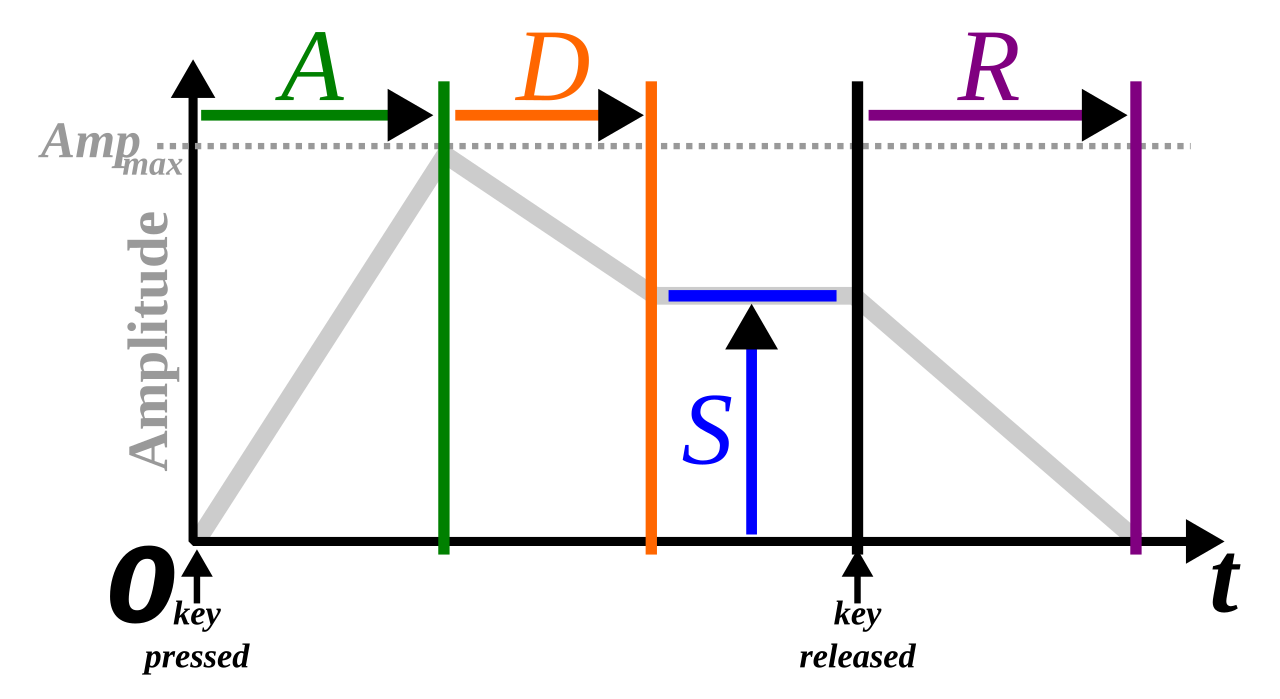

These four parameters describe the complete amplitude envelope of a musical note. Every synthesizer on Earth uses some version of this model. Film composers, sound designers, game audio engineers — everyone speaks ADSR. It is the lingua franca of sound.
Now, let’s look at what these words actually mean.
3. ADSR: What the Letters Actually Stand For
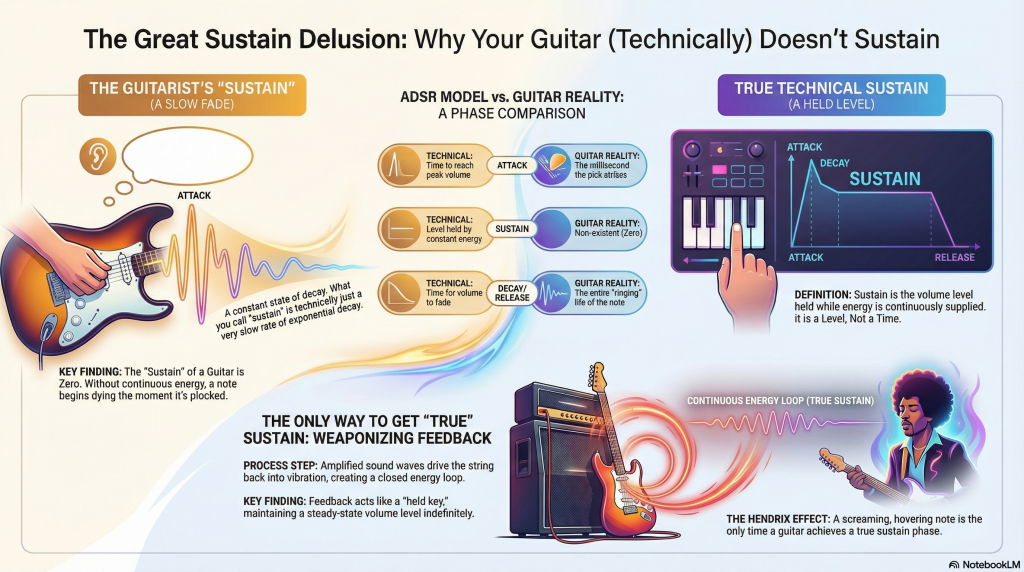
Here is the formal definition, drawn from the peer-reviewed literature (well, Wikipedia, which is close enough for our purposes):
Attack
“Attack is the time taken for the rise of the level from nil to peak.”
You press a key (or pluck a string). The sound goes from silence to its loudest point. That rise is the attack. Fast attack = sharp, percussive onset. Slow attack = gradual fade-in.
For a guitar: you strike the string with a pick. The sound rockets from silence to peak amplitude in a few milliseconds. Explosive attack. Check. ✅
Decay
“Decay is the time taken for the level to reduce from the attack level to the sustain level.”
After the initial peak, the sound settles down to a lower, more stable level. That settling is the decay. Think of a piano: the initial hammer strike is loud, then it quickly drops to a quieter tone that rings on.
Sustain
“Sustain is the level maintained until the key is released.”
Read that again. Sustain is a level, not a time. While attack, decay, and release are all measured in time (seconds, milliseconds), sustain is measured in amplitude (volume). It is the steady-state volume that a note holds while the player continues to supply energy.
On a synthesizer, as long as your finger holds down a key, the note stays at the sustain level. On a violin, as long as the bow moves across the string, the note sustains. On a pipe organ, as long as the air flows, the pipes sing.
The critical prerequisite: continuous energy input.
Release
“Release is the time taken for the level to decay to nil.”
You let go of the key. You lift the bow. You stop the airflow. The note fades from whatever level it was at (the sustain level) down to silence. That fade is the release.
4. Houston, We Have an Electric Guitar Sustain Problem
Now let’s apply the ADSR model to a plucked electric guitar string u2014 and see why electric guitar sustain is a myth.
Attack: You strike the string. Amplitude shoots from zero to peak. Duration: a few milliseconds. ✅ No issues here.
Decay: Amplitude drops from its initial peak toward the sustain level. But what IS the sustain level of a guitar? This is where things start to unravel.
Sustain: Remember the definition — sustain is the level maintained while the key is held, while energy continues to be supplied. But the pick left the string three milliseconds ago. The guitarist’s right hand is no longer supplying any energy whatsoever. The string is on its own, vibrating purely on stored mechanical energy, fighting a losing battle against friction, air resistance, and energy transfer into the guitar body.
There is no continuous energy input. There is no key being held down. There is no bow maintaining contact. There is nothing keeping the note alive except the string’s residual momentum and the body’s reluctance to absorb it.
The sustain level of a plucked guitar string is, by definition: zero.
If the sustain level is zero, then the decay phase goes from peak amplitude all the way down to zero. And if the decay goes to zero, there is no sustain phase at all, and no release phase either — because there’s nothing left to release from.
To put it in plain English:
The entire “ringing” of a guitar note — everything after the pick attack — is the decay phase.
Every bit of it. From the moment the pick leaves the string to the moment the last feeble vibration dies out in silence: decay, decay, decay.
5. But Wait — What About the Release?
Now here’s where it gets properly entertaining, and where your original intuition deserves its due.
There is an alternative interpretation — and it’s arguably even more provocative.
Consider this: a guitar pluck is instantaneous. The energy transfer from pick to string lasts perhaps 1–10 milliseconds. In synth terms, pressing a key and releasing it at almost the same instant is what happens when you play staccatissimo. The “key” — the pluck — is pressed and released in virtually the same motion.
Under this interpretation:
- Attack: The brief moment the pick drives the string (~1–10 ms)
- Decay: Essentially zero time, because the “key” is already released before the sound can settle to a sustain level
- Sustain: None (the key was released immediately)
- Release: EVERYTHING. The entire glorious ringing of the note, from peak to silence, is the release phase.
So what guitarists call “sustain” might not just be the wrong ADSR parameter — it might be the one parameter that is maximally the opposite of what actually occurs.
The thing you call sustain is the release. The thing you do to stop it (muting) doesn’t trigger the release — the release was already happening the entire time.
6. The Physics Don’t Lie (They Just Politely Disagree)
From a physics standpoint, a vibrating guitar string is a textbook example of a damped harmonic oscillator — specifically, an underdamped system. The amplitude envelope follows the equation:
y(t) = A · e−λt · cos(ωt − φ)
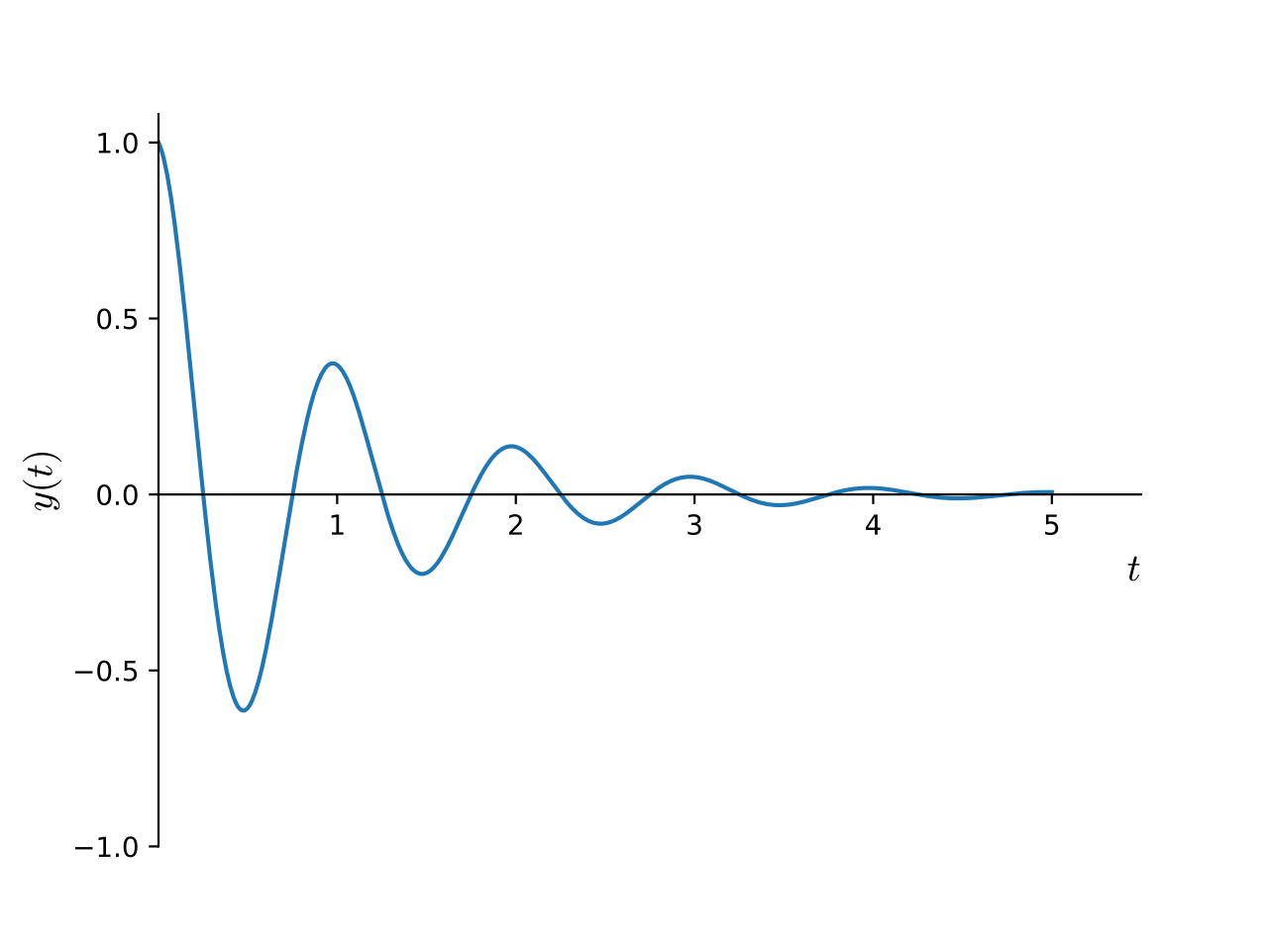

Where:
- A = initial peak amplitude
- λ = the decay rate
- ω = angular frequency
- φ = phase angle
That e−λt term is the tell. It’s a pure exponential decay function. No sustain. No plateau. No steady state. The amplitude is always decreasing, from the very first oscillation after the pluck, all the way to silence.
What guitarists call “great sustain” is really just a low value of λ — a slow decay rate. The string loses energy slowly because:
- The body is rigid and doesn’t absorb vibration easily (hello, heavy Les Paul)
- The nut and bridge transfer minimal energy (hello, quality hardware)
- The neck joint is tight and stable (hello, threaded inserts — wink)
- The string quality is high and elongation is minimal
But it’s still decay. Always decay. The exponential function doesn’t know the word “sustain.” It only knows how to shrink.
7. So Why Do We Call It Sustain?
Because musicians are poets, not physicists. And that’s a beautiful thing. The term “electric guitar sustain” stuck because it feels right u2014 even if the physics disagree.
The word “sustain” entered guitar vocabulary long before synthesizers existed. When a guitarist in 1955 said a Les Paul had “great sustain,” they meant “the note lasts a long time.” The word made colloquial sense: the note sustains — it keeps going. The Latin root sustinēre means “to hold up, to endure.” A note that endures? That sustains. Perfectly reasonable.
It’s only after Robert Moog built his envelope generator in the 1960s and ARP formalized the ADSR model that “sustain” acquired a precise technical definition — one that fundamentally conflicts with how guitarists use the word.
The guitar community is not wrong. They’re just operating under an older, perfectly valid definition of the English word. Meanwhile, the synthesizer community defined the term with mathematical precision and moved on.
Two tribes. One word. No communication. And so the electric guitar sustain myth was born.
8. Plot Twist: When Guitars Actually DO Have Sustain

Just when we’ve built an airtight case that electric guitars can never truly sustain, there’s one glorious exception — and every guitarist who’s ever stood too close to a cranked amplifier knows exactly what it is.
Feedback.
Here’s the scenario: you play a note, and the amplified sound waves from the speaker travel back through the air and hit the guitar body and strings. If the conditions are right — if the frequency of the sound wave matches a resonant frequency of the string — the acoustic energy from the speaker drives the string back into vibration. The string steals energy from the speaker, which steals energy from the amp, which steals energy from the pickup, which steals energy from the string, which is being replenished by the speaker. A beautiful, screaming, closed loop.
And suddenly, everything changes.
In ADSR terms, the speaker has become the equivalent of a held key. There is now continuous energy input flowing into the string. The amplitude doesn’t decay — it stabilizes, or even increases. The note hangs in the air, unwavering, for as long as the guitarist stands in the right spot at the right angle with the right amount of gain.
This is, by any reasonable definition, a sustain phase. A level, maintained by continuous energy input, lasting as long as the “key” (the feedback loop) is active. When the guitarist steps away or mutes the string, the feedback loop breaks, and the note enters its release phase — fading to silence.
Feedback is the one and only scenario where an electric guitar achieves true ADSR sustain.
And it’s no coincidence that this is the technique guitarists most naturally describe as “sustaining a note.” Jimi Hendrix letting a single note scream and hover over the audience at Monterey. Santana coaxing endless singing tones from his SG through a roaring Mesa/Boogie. That’s not decay. That’s not release. That’s sustain — in the full, proper, Robert-Moog-approved sense of the word.
Of course, this also means that the only way your guitar genuinely sustains is when you surrender control to a feedback loop between wood, wire, magnets, air, and a very loud amplifier. Which is, if you think about it, the most rock and roll thing imaginable.
The Professor approves.
9. Implications for the Discerning Guitarist
Does any of this redefine electric guitar sustain in practice? Absolutely not.
If swapping your neck screws for threaded inserts makes your guitar ring like a bell, you can call it “sustain” — we’ll know what you mean. If a fresh set of strings makes notes last longer, say it has “better sustain” — nobody will correct you. (Well, almost nobody. You’ve met the Mad Professor now.)
But the next time you’re in a heated forum debate about tonewood and sustain, you can drop this little bomb:
“Actually, electric guitars don’t have sustain. What you’re hearing is the decay phase of a damped harmonic oscillation governed by an exponential envelope function. Or possibly the release phase, depending on your interpretation of the pluck as a key-press event. Unless you’re talking about feedback — in which case, carry on.”
Then stand back and watch the world burn. 🔥
10. Conclusion
Electric guitars don’t have sustain. They have a beautifully slow, exponentially decaying release (or a very long decay, depending on whom you ask). The ADSR model — the internationally recognized framework for describing how notes behave — defines sustain as a level, not a duration, and requires continuous energy input to maintain it. A plucked string has no continuous energy input. Therefore: no sustain.
Unless you crank your amp, stand in the sweet spot, and let feedback do the work — in which case, congratulations, your guitar finally has real sustain. All it took was weaponizing the laws of acoustics.
What guitarists call electric guitar sustain in normal playing is the instrument’s resistance to amplitude decay — a property determined by mass, rigidity, coupling efficiency, string quality, and yes, the hardware that holds it all together.
So the next time someone asks about your guitar’s sustain, you have three options:
- Nod and say “It’s fantastic.”
- Launch into a ten-minute explanation of the ADSR envelope, Robert Moog, exponential decay functions, and the difference between a level and a duration.
- Crank your amp to 11, point your guitar at the speaker, and let the laws of physics demonstrate actual sustain — Hendrix style.
Option 1 will make you more friends. Option 2 will make you the Mad Electric Guitar Professor. Option 3 will make you both — but also possibly deaf.
We know which one we’d choose. 🎸
Related Reading
- 3 Reasons Why Guitar Neck Screw Inserts Are Better for Bolt-On Guitars
- Screw Your Guitar Neck Tightly
- To Glue or Screw… That’s the Question
The Mad Electric Guitar Professor is a column exploring the delightfully nerdy intersection of musical engineering, guitar mythology, and things nobody asked about but everyone needs to know. Published on the Nectite blog — because we make guitar hardware, and we’re contractually obligated to think about this stuff.
References:
- Pinch, T. & Trocco, F. (2004). Analog Days: The Invention and Impact of the Moog Synthesizer. Harvard University Press.
- Vail, M. (2014). The Synthesizer: A Comprehensive Guide. OUP USA.
- “Envelope (music)” — Wikipedia. Retrieved 2025.
- “Damping” — Wikipedia. Retrieved 2025.
- “String vibration” — Wikipedia. Retrieved 2025.
- Hendrix, J. (1967). Live at Monterey — experimental evidence of true guitar sustain via feedback.
- Your guitar forum argument at 2 AM — primary source.