
A Mildly Academic Investigation into Whether Your Neck Joint Actually Matters for Sustain
Abstract
Since the dawn of the electric guitar era, a holy war has raged in forums, workshops, and music shops worldwide: does a glued (set-in) neck produce more sustain than a bolted-on one? Disciples of Gibson swear by the dovetail. Fender faithful worship the four-screw plate. And the neck-through crowd watches from the sidelines, smugly convinced they’ve transcended the debate entirely. This paper — and I use that word with characteristic recklessness — examines the physics, cites the one scientist who actually bothered to measure it, and arrives at a conclusion that will annoy practically everyone.
You’re welcome.
1. Introduction: The Three Tribes of Neck Joinery
Walk into any guitar shop and ask a simple question: “Which guitar has the best sustain?”
Then sit back. Brew some coffee. You’ll be here a while.
Within seconds, the salesperson will invoke the sacred trinity of guitar construction: bolt-on, set-neck, and neck-through. They’ll explain — with the absolute certainty of someone who learned this from another salesperson — that the method by which a guitar’s neck attaches to its body fundamentally determines how long your notes ring out.
The hierarchy, as every forum post since 1997 has established, goes like this:
- Neck-through — The most sustain. One continuous piece of wood from headstock to bridge. The vibrations flow like a river with no dams. Pure. Uninterrupted. Expensive.
- Set-neck (glued) — Almost as good. A tightly fitted dovetail joint, permanently bonded with glue. The gap between neck and body is sealed. A solid second place. Very Gibson.
- Bolt-on (screwed) — The budget option. Four screws, a metal plate, and a prayer. A mechanical barrier that kills sustain. Very Fender.
This hierarchy has been repeated so many times it has become gospel. It is taught in guitar schools. It’s printed on product pages. It is the single most universally agreed-upon ranking in all of electric guitar mythology.
There’s just one tiny problem: only one person has ever actually tested it.
And he found it was wrong.
2. A Brief Taxonomy of Neck Joints (or: How Did We Get Here?)
Before we reach the uncomfortable part, let’s give each method its due. After all, they’ve earned their reputations — even if those reputations might be slightly… ornamental.
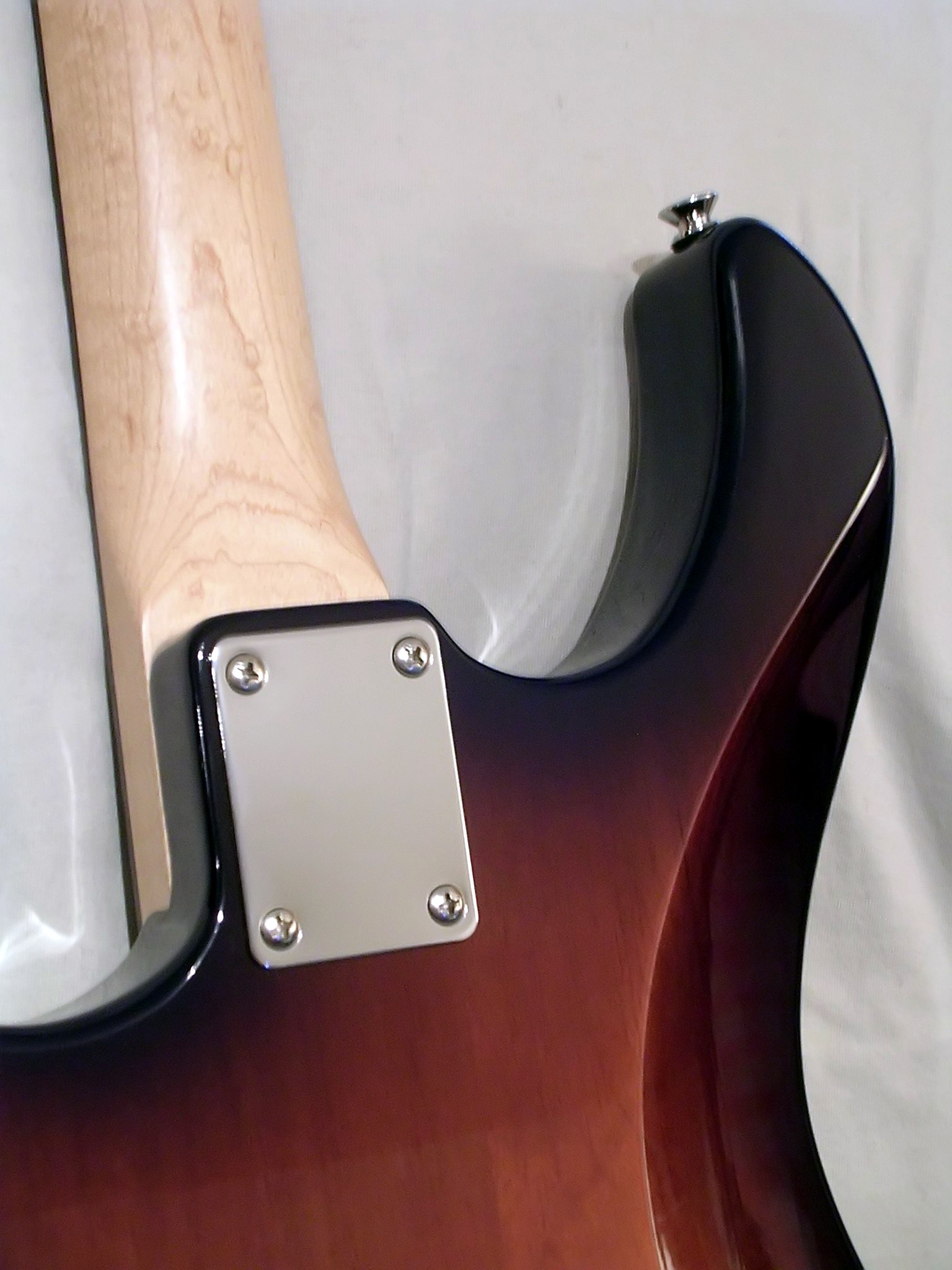
The Bolt-On: Born from Practicality
In 1950, Leo Fender — a man who, famously, did not play guitar — revolutionized instrument manufacturing. His Telecaster (née Broadcaster, née Esquire, née “that slab with a neck screwed on”) used a radical concept: build the neck separately, build the body separately, and join them with four wood screws and a metal plate.
This was genius. Not for tone. For manufacturing. If the neck was crooked, pull it off and try another. If the body had a flaw, swap it out. Guitar repair went from “steam the glue and pray” to “grab a Phillips-head screwdriver.”
The term “bolt-on” is actually a misnomer — most bolt-on guitars use wood screws, not actual bolts with nuts. The screws thread directly into the wood of the neck heel, which is inserted into a routed pocket in the body. Brian May’s legendary Red Special is one of the rare exceptions that uses an actual bolt.

The Set-Neck: The Artisan’s Choice
Long before Fender picked up a screwdriver, luthiers were gluing necks into bodies. The traditional set-neck (or set-in neck) uses a tightly fitted mortise-and-tenon or dovetail joint, secured with wood glue. When the glue cures, the bond is permanent — in theory, as rigid as if the two pieces had grown from the same tree.
Gibson made this their signature. Every Les Paul, SG, ES-335, and Flying V that left the Kalamazoo factory had a neck glued into its mahogany body. Paul Reed Smith followed suit. So did Gretsch. The set-neck became synonymous with quality, craftsmanship, and — here comes the dangerous word — sustain.
The Neck-Through: Going All the Way
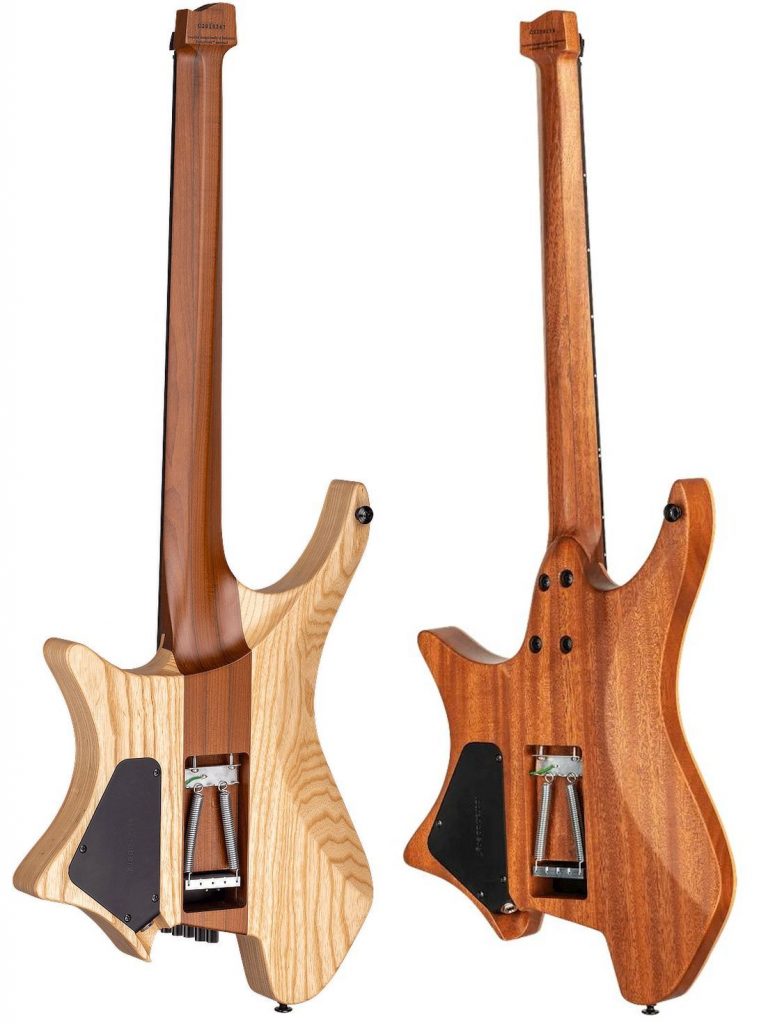
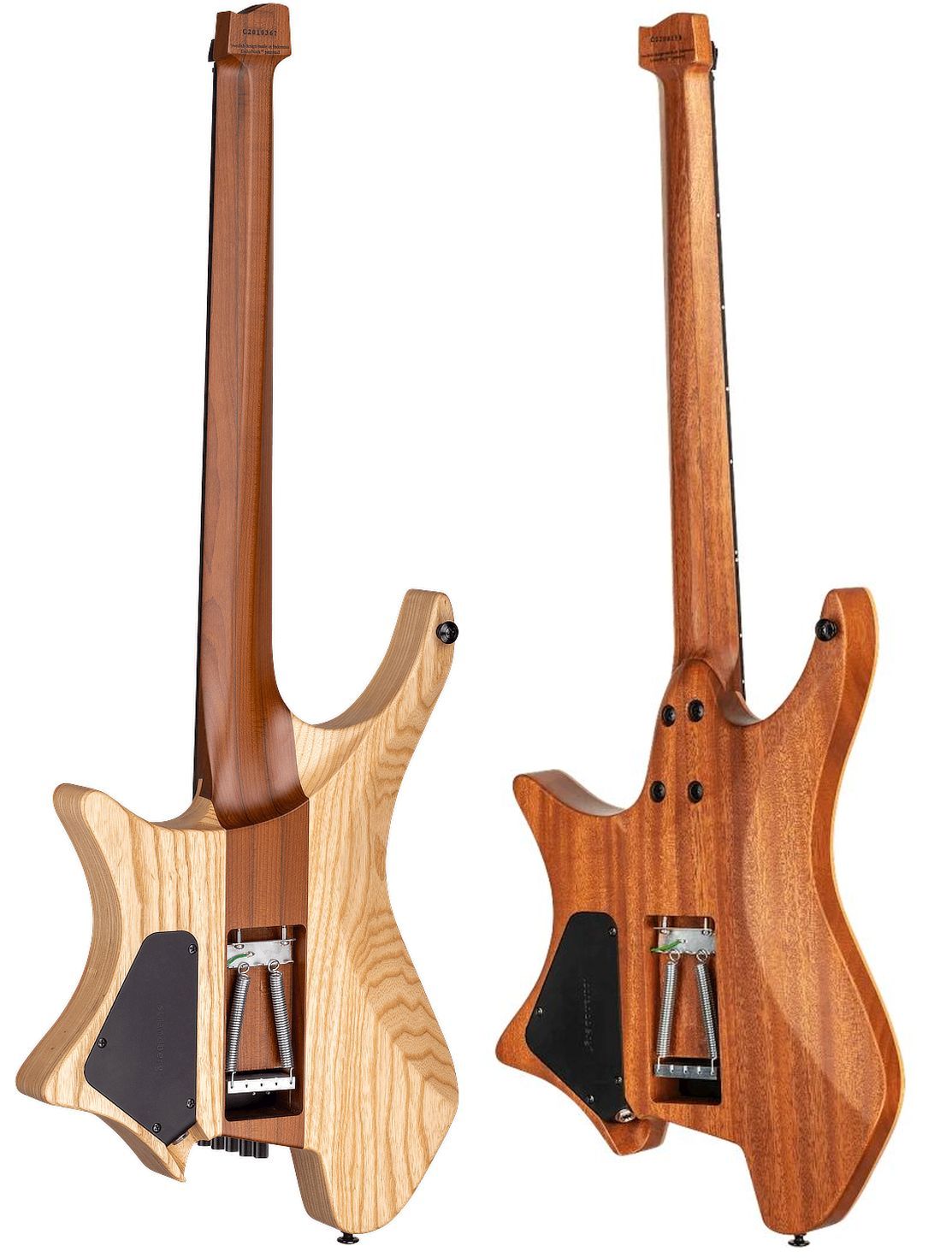
Then there’s the nuclear option. In a neck-through design, the neck and the central core of the body are a single piece of wood (or laminated from multiple strips). Side “wings” are glued on to complete the body shape. Pickups, bridge, and everything else mount directly on this continuous core.
Early pioneers include Rickenbacker (1956), who later inspired the iconic Gibson Firebird and Thunderbird. Today, the method is beloved of metal players — companies like Jackson, ESP, Schecter, and Ibanez use it on their higher-end models.
Neck-through guitars are often claimed to have the greatest sustain of all: one uninterrupted piece of wood carrying vibrations from nut to bridge. No joint, no barrier, no compromise. What could possibly go wrong with this logic?
Quite a lot, actually.

3. The Conventional Wisdom (and Why It’s So Convincing)
Let’s be fair to the conventional wisdom. It’s not stupid. In fact, it’s quite logical. Here’s the argument:
Sustain depends on how efficiently vibration energy transfers between the neck and body. The string vibrates. That vibration passes through the bridge into the body, and through the nut (and fret contact points) into the neck. The neck and body together form a coupled system that vibrates sympathetically. The more efficiently this coupling works, the less energy is lost, and the longer the note rings.
From this premise, the ranking follows naturally:
- A neck-through has no joint at all — maximum coupling. The wood is continuous. Vibration transfer is perfect.
- A set-neck has a tight glue joint — strong coupling. The glue fills any gaps between the mating surfaces, creating a near-rigid bond.
- A bolt-on has screws pushing two surfaces together — weaker coupling. There’s inevitably a tiny gap, a micro-pocket of air, where vibration energy gets partially reflected back instead of transferred. Like a bridge with a crack in it.
This sounds so reasonable. So physically intuitive. So satisfyingly hierarchical.
There’s just one problem.
4. Enter Dr. Mottola (or: The Man Who Brought a Microphone to a Forum Fight)
In 2007, R.M. Mottola — a luthier, engineer, and researcher — published a paper in American Lutherie (Issue 91, p. 52) titled “Sustain and Electric Guitar Neck Joint Type.”
This paper is remarkable for two reasons:
- It is, to this day, the only documented experimental measurement of sustain across different neck joint types on otherwise identical guitars.
- Its conclusion made a lot of people very uncomfortable.
Mottola’s experiment was elegant. Rather than comparing a Les Paul to a Stratocaster (which differ in approximately 847 ways), he controlled for variables. He measured sustain — defined as the time for a plucked string’s amplitude to decay below a threshold — across guitars with bolt-on, set-in, and neck-through construction, controlling for other factors like body wood, string gauge, scale length, and pickup type.
His finding?
There was no measurable correlation between neck joint type and sustain duration.
Read that again. The one time someone actually measured it, the “bolt-on = less sustain” hierarchy collapsed. The bolt-on guitars sustained just as long as the set-neck and neck-through instruments.
Wikipedia — not exactly a radical publication — summarizes it plainly. On the set-in neck page: “the attribution of long sustain has been definitively contradicted by experimentation.” On the neck-through page: “Scientific studies on the subject are lacking, and at least one experiment seemed to contradict the logic.”
The Emperor of Neck Joints had no clothes.
5. But Why? The Physics of Coupling (or: It’s Not What You Join, It’s How You Join It)
If the joint type doesn’t determine sustain, what does? The answer lies in coupling stiffness — a concept from mechanical vibration theory.
When two vibrating bodies are connected, energy transfers between them. The efficiency of that transfer depends not on what material connects them, but on how rigid the connection is. In engineering terms, what matters is the impedance match at the boundary.
Let’s think about it with a simple analogy:
Imagine holding two tuning forks. Press them against each other tip-to-tip. If you press hard — creating a rigid contact — striking one will cause the other to vibrate in sympathy. The vibrations transfer beautifully. Now hold them together loosely, barely touching. Strike one, and the other barely notices. The energy gets reflected at the sloppy boundary instead of transmitted through it.
The key insight is this: a well-clamped bolt-on connection can be just as rigid as a glued joint. Conversely, a poorly fitted set-neck with gaps in the dovetail can be worse than a tight bolt-on.
The coupling stiffness depends on:
- Surface contact area — How much of the neck heel actually touches the body pocket?
- Clamping force — How tightly are the two surfaces pressed together?
- Surface finish — Are the mating surfaces smooth and flat, or loose and gappy?
- Stability over time — Does the connection stay tight, or does it work loose?
None of these factors are inherent to the joint type. They’re all about the joint quality.
A set-neck with a sloppy dovetail and too-thin glue? Poor coupling. A bolt-on with a perfectly routed pocket, flat mating surfaces, and high clamping pressure? Excellent coupling. Possibly better coupling than the set-neck, because the mechanical force can actually exceed what glue alone provides.
6. The Dirty Secret of Wood Screws (or: Where This Gets Interesting for Us)
Now, here’s where the Professor must make a confession. I work for Nectite. We sell guitar neck screws and threaded inserts. So I have a professional interest in this conversation. But I promise you — the science came first, and the product relevance is a happy coincidence.
Okay, not entirely a coincidence. But still.
Here’s the thing. The standard bolt-on guitar uses wood screws. You know the kind — coarse-threaded screws that bite directly into the wood of the neck heel. Leo Fender used them in 1950, and most manufacturers still do today.
Wood screws work. But they have a physics problem: every time you remove and reinstall them, the screw holes get slightly larger. The threads in the wood compress and wear. The clamping force decreases. The once-tight neck pocket develops micro-play. The coupling loosens.
And remember: coupling stiffness is what actually determines vibration transfer! Not the joint type — the joint quality.
This is where threaded inserts enter the picture. A threaded insert is a metal socket that gets permanently installed into the neck heel. Instead of a wood screw threading into soft wood, a precision machine screw threads into hardened steel or stainless steel. The result:
- Consistent clamping force — every time you reattach the neck, you get the same tightness
- No thread degradation — metal-on-metal threads don’t wear out like wood
- Higher maximum clamping pressure — you can torque a machine screw tighter than a wood screw without stripping
- Repeatable disassembly — remove the neck for maintenance or adjustment, reinstall it perfectly
In coupling stiffness terms: threaded inserts don’t change a bolt-on into a set-neck. They make the bolt-on the best possible version of itself. Maximum clamping force. Maximum surface contact. Maximum coupling stiffness. Every time.
Taylor Guitars figured this out decades ago — their acoustic guitars use a bolt-in system with threaded inserts in the neck heel. It’s one of the most acclaimed neck joints in the acoustic world.
7. “But My Les Paul Sustains More Than My Strat!”
I hear you. And I believe you. Your Gibson likely does sound different from your Fender. It might ring longer, feel warmer, sustain more. But that’s not because of the neck joint. It’s because Les Pauls and Stratocasters differ in approximately one thousand other ways:
| Factor | Typical Les Paul | Typical Stratocaster |
|---|---|---|
| Body wood | Mahogany + maple cap | Alder or ash |
| Body weight | ~4–5 kg | ~3.2–3.6 kg |
| Scale length | 24.75″ (628mm) | 25.5″ (648mm) |
| Bridge type | Tune-O-Matic (fixed) | Tremolo (floating) |
| Neck wood | Mahogany | Maple |
| Pickups | Humbuckers | Single coils |
| Strings | Often .010–.046 | Often .009–.042 |
| Nut material | Various | Various |
The bridge alone accounts for a massive sustain difference. A fixed Tune-O-Matic transmits vibration far more efficiently than a floating tremolo bridge with springs absorbing energy in the back cavity. If you blocked the tremolo on your Strat, you’d recover a significant portion of that “missing” sustain — without changing the neck joint at all.
String gauge matters. Pickup output matters. Body mass and rigidity matter. Nut material matters. Fret material matters. The quality of the neck attachment matters.
The joint type? According to the only person who measured it: nope.
8. The Real Question You Should Be Asking
So if “bolt-on vs. glued vs. neck-through” isn’t the question that matters, what is?
The right question is: “How good is the coupling between my guitar’s neck and body?”
And the answers that actually improve coupling are surprisingly mundane:
- Is the neck pocket tight? A well-routed pocket with minimal air gap matters more than whether you use screws or glue.
- Are the mating surfaces flat and smooth? Wood-to-wood contact should be maximized. Paint or thick finish in the pocket? Not ideal.
- Is the clamping force consistent? Whether from glue, bolts, or screws — is the joint actually tight?
- Does it stay tight? Glue doesn’t loosen (unless it fails). Wood screws can loosen over time. Threaded inserts with machine screws give you the permanence of a bolted connection with the removability of a bolt-on.
The ultimate irony is that a well-executed bolt-on with threaded inserts might provide more consistent coupling than a set-neck — because you can disassemble it, check the fit, clean the surfaces, and reassemble with known torque. A set-neck, once glued, is a black box. Was the fit perfect? Was there enough glue? Too much? You’ll never know. It’s Schrödinger’s dovetail.
9. Conclusion: The Professor’s Verdict
To glue or to screw? Shakespeare never had to answer this one, but I will:
It doesn’t matter.
What matters is coupling stiffness, surface contact, and clamping force. A masterfully built bolt-on will outperform a sloppy set-neck every day of the week. A tight neck-through will behave nearly identically to a tight set-neck. The joint type is a manufacturing decision, not an acoustic one.
So the next time someone on a forum insists that set-necks “obviously” sustain longer, politely point them toward Mottola (2007) and watch the fireworks.
And if you happen to play a bolt-on guitar — as the vast majority of guitarists do — know this: your neck joint is not holding you back. Not even a little. Especially not if you’ve upgraded from wood screws to threaded inserts (hello — wink).
Now go play your guitar. Whatever it’s made of. However it’s joined together.
The notes don’t care.
— The Mad Electric Guitar Professor
References
- Mottola, R.M. (2007). “Sustain and Electric Guitar Neck Joint Type.” American Lutherie, Issue 91, p. 52.
- Burrluck, Dave (1998). “Types of neck.” The Player’s Guide to Guitar Maintenance. Balafon Books. ISBN 978-0-87930-549-9.
- Lipman, Barry (2002). “What are the pros and cons of bolt-on necks.” Guitar Questions: The Novice’s Guide to Guitar Repairs. Cherry Lane Music Co. ISBN 978-1-57560-452-7.
- “Bolt-on neck.” Wikipedia. Retrieved 2026.
- “Set-in neck.” Wikipedia. Retrieved 2026.
- “Neck-through-body construction.” Wikipedia. Retrieved 2026.
- That midnight forum thread where someone with 47 posts definitively proved set-necks sustain more by posting a YouTube video recorded on a phone from 2009. Primary source.