
A Mildly Academic Investigation into the World’s Most Popular Guitar Repair
By The Mad Electric Guitar Professor
Abstract
The “toothpick and wood glue” repair for stripped guitar neck screw holes is arguably the most widely recommended fix in all of lutherie. It appears in every forum, every YouTube tutorial, and every “Guitar Maintenance 101” article ever written. It is also, from a mechanical engineering perspective, a fascinating exercise in wishful thinking. This article subjects the toothpick fix to the kind of forensic analysis it has never received — examining fiber orientation, shear strength, adhesive bonding, and clamping force to determine whether this folk remedy deserves its reputation. Spoiler: the physics has opinions.
1. The Crime Scene
Let’s set the stage.
You’re a guitarist. You’ve owned your bolt-on for a few years. At some point — maybe to adjust the truss rod, maybe to fit the guitar in a gig bag for a flight, maybe just because you were curious — you removed the neck. Then you put it back. Then you removed it again. And again.
Now one of the four neck screws just… spins. It doesn’t bite. It doesn’t tighten. It just rotates freely in its hole like a tiny, useless carousel. Your neck wobbles. Your sustain has vanished. Something must be done.
You open a browser. You type “stripped neck screw hole fix.” And the internet, in perfect unison, offers you the same advice it has offered every guitarist since approximately the invention of the internet:
“Just jam some toothpicks in there with wood glue. Works great.”
And here, dear reader, is where a forensic engineer begins to twitch.
2. The Defendant: A Profile of the Common Toothpick
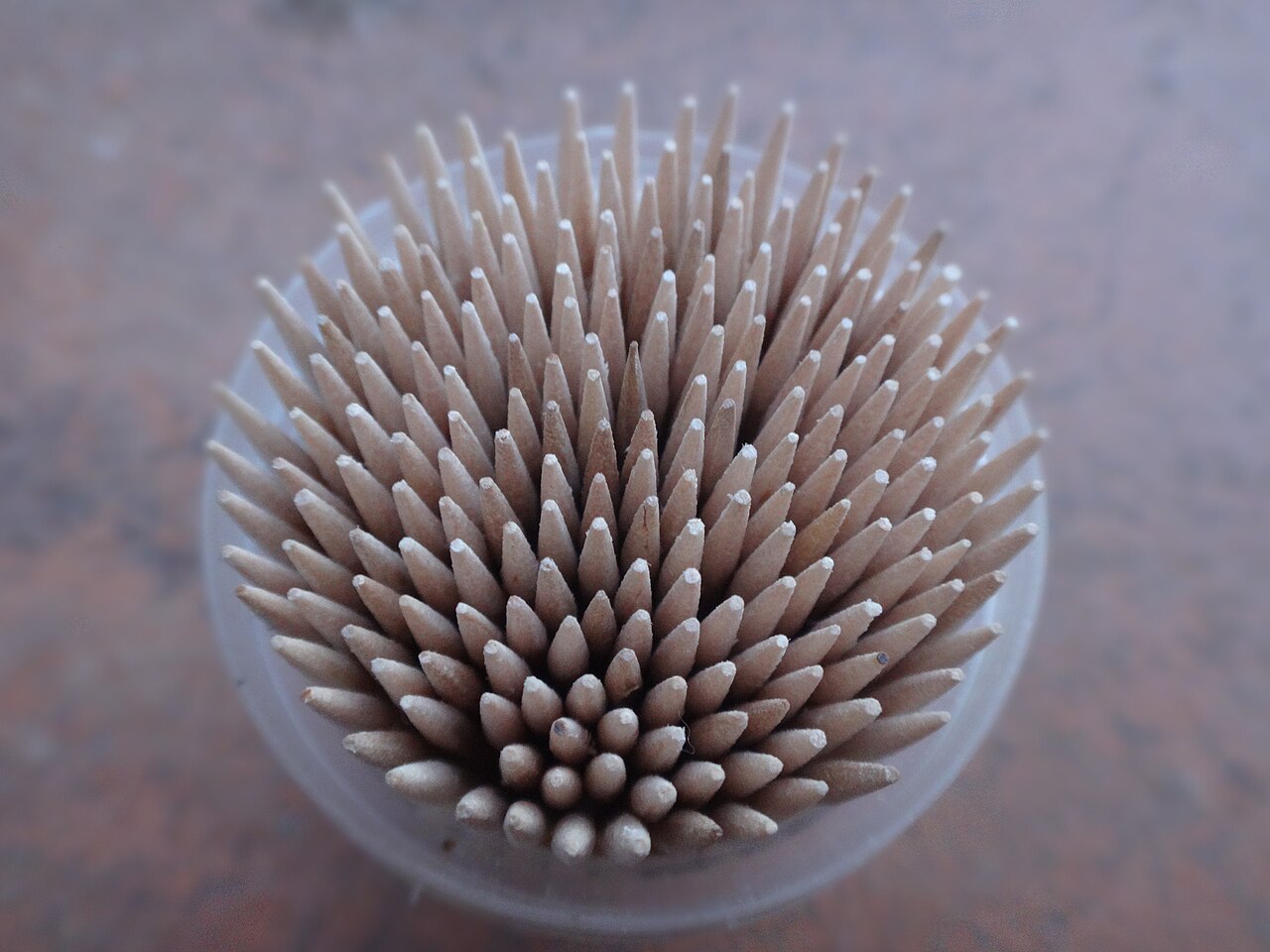

Before we can evaluate the repair, we must understand the materials involved. Let us begin with the humble toothpick.
The standard wooden toothpick — the round, double-pointed kind you find on every restaurant table — is made of birch (Betula). Birch is used because it’s cheap, readily available, non-toxic, flavorless, and easy to machine into thin cylinders at scale. It’s the same reason birch is used for popsicle sticks, tongue depressors, and cheap wooden dowels.
Here are the mechanical properties that matter for our purposes:
| Property | Birch (Toothpick) | Hard Maple (Guitar Neck) |
|---|---|---|
| Janka Hardness | ~1,260 lbf (Yellow Birch) | ~1,450 lbf (Hard Maple) |
| Shear Strength (parallel to grain) | ~1,480 psi | ~2,330 psi |
| Specific Gravity | 0.55–0.62 | 0.63 |
| Compression (parallel to grain) | ~5,600 psi | ~7,830 psi |
Sources: USDA Forest Products Laboratory, Wood Handbook (FPL-GTR-282), 2021.
Notice anything? The toothpick material is softer and weaker than the guitar neck it’s being asked to reinforce. In every relevant mechanical property — hardness, shear strength, compression — birch scores lower than hard maple.
This is the equivalent of reinforcing a cracked concrete wall by stuffing it with plaster of Paris. It fills the space. It does not replicate the structural properties of the material it’s replacing.
3. The Forensic Analysis: Why Toothpicks Fail
Let’s examine the failure modes of the toothpick repair with the cold, dispassionate eye of an engineer who has probably spent too long thinking about this.
3.1 Fiber Orientation: The Silent Killer
This is the big one, and almost nobody talks about it.
Wood has dramatically different mechanical properties depending on which direction you load it relative to the grain. For shear strength:
- Parallel to grain (shear along the fibers): ~2,330 psi for hard maple
- Perpendicular to grain (shear across the fibers): roughly 25–50% of parallel value
When a guitar neck screw hole is drilled, it goes straight down into the neck — essentially parallel to the grain direction of the maple. The original wood fibers surrounding the hole are oriented to resist the screw’s lateral forces.
Now consider the toothpick. It is a long, thin cylinder. Its grain runs along its length — that’s what makes it strong enough not to snap when you pick your teeth. When you jam it into a screw hole, the toothpick’s grain is aligned parallel to the screw hole’s axis — which means it’s oriented perpendicular to the forces the screw applies.
The toothpick’s strongest axis is pointed the wrong way.
The screw thread needs to grip wood fibers that resist lateral shearing. The toothpick’s fibers are oriented to resist axial compression (pushing the toothpick deeper), not lateral shearing (the screw thread trying to cut sideways into them).
This is the fundamental flaw. You’re filling the hole with material that is weaker than the original, and that material is oriented in the worst possible direction for the loads it will face.
3.2 The Glue Line Problem
“But,” the forum replies, “the wood glue bonds everything together!”
Let’s talk about PVA wood glue — the standard yellow or white wood glue (Titebond, etc.) that everyone uses for this repair.
PVA wood glue is excellent at bonding long-grain to long-grain surfaces. In a well-clamped, well-fitted joint, the glue line can actually be stronger than the surrounding wood. This is why edge-glued panels work so well — the glue joint is as strong as the wood itself.
However, PVA is significantly weaker in:
- End-grain to end-grain bonds (the glue partially soaks into the open pores, creating a “starved” joint)
- End-grain to long-grain bonds (mismatched porosity)
- Gap-filling applications (PVA shrinks as it dries; it needs tight-fitting joints to work)
Now, what kind of joint is a toothpick jammed into an oversized, irregular, stripped screw hole?
It is: end-grain-to-long-grain, poorly fitting, gap-filling, and unclamped.
This is a greatest-hits album of PVA failure modes.
The shear strength of a PVA glue line under ideal conditions is approximately 3,000–4,000 psi. Under the conditions of a toothpick repair? You’re likely getting a fraction of that — perhaps 1,000–1,500 psi at the actual bond surfaces. And the bonded surface area is tiny: the irregular contact patches between round toothpick fragments and an oval, chewed-up hole.
3.3 The Math: Reinsertion Cycles
Here’s where it gets ruthless.
A neck screw stripped because the wood fibers around the original hole were destroyed through repeated insertion and removal. The original maple had a shear strength of ~2,330 psi and it failed after (typically) 2–5 removal cycles, depending on technique and wood quality.
The toothpick repair offers:
- Material shear strength: ~1,480 psi (birch, best case)
- Effective shear strength (accounting for perpendicular grain orientation): ~750–1,100 psi
- Glue bond contribution: variable, but degraded by end-grain contact and poor fit
- Combined effective resistance: somewhere in the neighborhood of 800–1,200 psi
And we’re asking this improvised composite to resist the same forces that destroyed 2,330 psi maple.
The toothpick repair doesn’t just have less holding power than the original. It has roughly one-third to one-half the holding power.
Translation: if your original screw holes lasted 4 removal cycles before stripping, the toothpick repair might last 1–2 cycles — if you’re gentle.
This is why forums are full of people performing the toothpick fix for the second time. The first time felt like it worked. The second time, they’re watching the same sad carousel.
4. But Wait — Does It Kind Of Work?
The Professor is nothing if not fair.
Yes. The toothpick fix “works” in a limited sense. If you:
- Use enough toothpicks to fill the hole snugly
- Apply adequate wood glue
- Let it dry for a full 24 hours
- Pre-drill a proper pilot hole before reinserting the screw
- Never remove the neck again
…then the repair can hold. The screw has something to bite into. The neck tightens down. You get clamping force.
The problem is condition #5. The moment you need to remove the neck — for a truss rod adjustment, for travel, for any maintenance — you’re back to square one, but now with an even more compromised hole full of glue residue, fragmented birch, and disappointment.
There’s also a psychological trap. Because the toothpick fix is so easy and universally recommended, guitarists assume it is good. It becomes the default. Many guitars go through three or four toothpick cycles before the player finally searches for something better — by which point the screw hole has been enlarged well beyond its original diameter, making any subsequent repair more difficult.
5. The Engineering Alternative
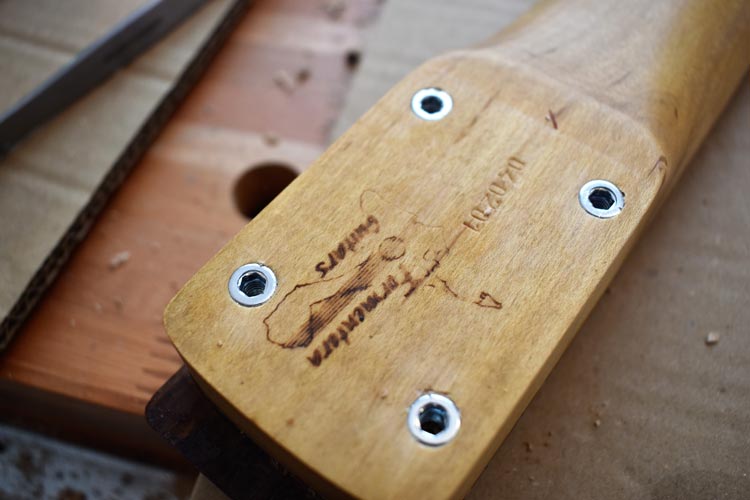
Here is where the Professor must disclose a professional interest: I work at a guitar hardware company. We make threaded inserts. I am, therefore, not a neutral party. But the physics doesn’t care who signs my paycheck, so let’s look at the numbers.
A threaded insert is a metal sleeve with external barbs or knurling that anchors into wood, and an internal machine thread that accepts a bolt. The screw threads into metal, not wood. The wood’s only job is to hold the cylindrical insert in place — a task it is very good at, since the insert’s external profile grips the wood circumferentially, distributing the load across a much larger surface area than a screw thread.
Here’s the comparison:
| Metric | Toothpick Fix | Threaded Insert |
|---|---|---|
| Screw threads into | Patched wood (birch + glue) | Metal (steel or brass) |
| Effective shear resistance | ~800–1,200 psi | Limited by metal thread, not wood |
| Removal/reinsertion cycles | 1–2 before re-stripping | 50+ with zero degradation |
| Clamping force | Moderate, inconsistent | 1,760–1,900 lbs estimated |
| Repeatability | Poor (varies with glue, fit) | Excellent (metal-on-metal, precise torque) |
The insert converts the joint from wood-on-wood (lossy, degrading) to metal-on-metal (precise, repeatable). It’s the same principle used in every IKEA furniture piece, every aircraft instrument panel, and every piece of CNC equipment that needs to be disassembled and reassembled with consistency.
It’s also the same principle German guitar builders were using in 1963. And that Ibanez adopted for their premium guitars in the late 1970s. The guitar industry didn’t invent the threaded insert — it just forgot to adopt it, because for Fender in 1954, a €0.10 wood screw was good enough for production-line economics.
6. The Verdict
Let the record show:
The toothpick fix is not worthless. It is a functional emergency repair. If you’re on tour, your neck is loose, and the only hardware store nearby is a gas station that sells toothpicks, absolutely do it. Get through the gig. Nobody is going to die.
But it is not a permanent solution. It is a repair that contains the seeds of its own failure. Every time you tighten the screw, you’re asking a fragile composite of misaligned birch fibers and gap-filled PVA to resist forces that destroyed hard maple. The math doesn’t work. The physics is politely but firmly unimpressed.
The permanent solution is to replace the mechanical interface. Stop asking wood to do a metal’s job. Install a threaded insert, and the problem disappears — not temporarily, not mostly, but completely.
Or, if you prefer: keep a bag of toothpicks in your gig bag. You’ll need them.
7. The Professor’s Summary for Forum Debates
Next time someone recommends the toothpick fix, you can drop any of these:
- “Birch has a shear strength 37% lower than the maple it’s replacing.”
- “The toothpick’s grain is oriented perpendicular to the screw’s shear plane.”
- “PVA glue loses most of its strength in end-grain-to-long-grain joints.”
- “German builders solved this in 1963 with threaded inserts.”
- “If the original maple lasted 4 cycles, your toothpick repair will last 1–2.”
Related Reading
- Your Guitar Neck Is Held On by Hope (and Four Mediocre Screws) The full engineering case for threaded inserts vs. wood screws
- How to Fix Stripped Guitar Neck Screws A Step-by-Step Guide
- How to Install Threaded Inserts for Guitar Neck Bolts
- FAQ: Threaded Inserts for Guitars
- Browse Nectite Threaded Insert Kits
Frequently Asked Questions
Does the toothpick fix really work for stripped guitar neck screws?
Temporarily, yes. Toothpicks and wood glue can fill a stripped hole enough for the screw to grip again. But birch toothpicks are 37% weaker than the hard maple they’re replacing, and the grain orientation is perpendicular to the screw’s shear forces giving roughly one-third to one-half the original holding power. Expect it to strip again after 12 removal cycles.
Why do toothpicks keep stripping out when I fix my guitar neck?
Three engineering factors work against the repair: (1) birch is softer than maple, (2) the toothpick grain runs perpendicular to the screw’s shear plane, and (3) PVA wood glue forms weak end-grain-to-long-grain bonds with poor gap-filling. The combined effective shear resistance is only 8001,200 psi versus the original maple’s 2,330 psi.
What is the best permanent fix for stripped guitar neck screw holes?
Threaded inserts. A metal insert embeds permanently in the neck and accepts a machine screw, converting the joint from wood-on-wood to metal-on-metal. This eliminates stripping entirely and provides consistent clamping force of 1,7601,900 lbs across 50+ removal cycles. Nectite kits start at €79.
Can I use hardwood dowels instead of toothpicks for a better repair?
Hardwood dowels (maple or oak) are better than birch toothpicks since they more closely match the neck wood’s strength. However, the grain orientation problem remains dowels inserted into the hole still have their grain perpendicular to the screw’s shear plane. Threaded inserts solve this permanently because metal threads don’t have a grain direction.